Your agent eval is silently wrong
A judge that returns nothing. A 429 that looks like a regression. Eight model configs benchmarked so you don’t have to.
The bug that started this
I was benchmarking an LLM-as-judge for agent regression testing. The first results looked reasonable: 85% precision, a handful of false alarms. Then I ran the baseline — the run where nothing changed — and 11 out of 120 healthy agent runs were flagged as failures.
The judge was not wrong. The judge was silent.
DeepSeek’s deepseek-v4-pro is a reasoning model. Reasoning tokens are billed
against max_tokens. I had set max_tokens to 200. The model spent all 200
tokens thinking, returned finish_reason: "length", and gave me an empty
content string:
{
  "finish_reason": "length",
  "content": "",
  "usage": {"completion_tokens_details": {"reasoning_tokens": 200}}
}
My client failed to parse that, and on parse failure it returned score: 0.0.
The downstream code read 0.0 < 0.5 and concluded: the agent regressed.
Nothing regressed. I had just built a machine that turns “I don’t know” into “it’s broken.”
That is the failure mode this post is about. Agent evaluation has a long tail of ways to be silently wrong, and almost all of them look like real signal.
What I was actually building
An agent run is hard to test with unit tests. It can call the right tool with the wrong argument, finish with a plausible but wrong answer, or double its token cost after a model swap — and your test suite stays green.
I built a small harness that treats an agent run as a test case:
OTel trace -> deterministic rubric -> judge -> report -> git-diffable JSON
The important design choice: it reads traces, not framework internals. If your
agent emits OpenTelemetry spans, it works. NVIDIA’s NeMo Agent Toolkit emits
OpenInference attributes rather than gen_ai.* — a normalization layer maps both
into one view, so a case written once survives a framework migration.
Everything below comes from measuring that harness against a constructed regression set.
The benchmark
- 120 synthetic agent tasks, each producing a baseline trace and a “degraded model” trace.
- 30 structural regressions: missing tool call, wrong tool, missing fact, token blowup, latency blowup, error span.
- 10 semantic regressions: the required fact is still present, but the answer is hedged — “the source was unavailable so this may be stale.” A substring check cannot see the difference.
- 80 unchanged runs, to measure false alarms.
Ground truth is constructed, so recall and precision are exactly measurable.
The deterministic layer alone:
| detector | recall | precision | false alarms |
|---|---|---|---|
| deterministic rubric | 75% (30/40) | 100% | 0 |
| naive “output non-empty” | 0% | — | 0 |
| naive “output got shorter” | 0% | — | 0 |
The deterministic layer catches every structural regression, never flags a healthy run, and costs nothing in tokens. That is the layer you always turn on in CI. The 10 remaining cases are the semantic tail — and that is exactly where an LLM judge earns its keep.
So I benchmarked eight of them.
Trap #1: the judge that scored zero because of a token budget
The bug from the intro. Two fixes:
# 1. Give reasoning models room to think AND answer
AEH_JUDGE_MAX_TOKENS=1500   # not 200

# 2. Never treat truncation as a verdict
if choice["finish_reason"] == "length":
    raise ValueError("judge response truncated by max_tokens")
After the fix, the “85% precision, 11 false alarms” result disappeared. The number was never about judge quality. It was a token-budget artifact wearing a verdict’s clothes.
Rule: a judge client that cannot distinguish “the model said no” from “the model said nothing” is not a judge. It is a random number generator with good manners.
Trap #2: a failed judge is not a regression
Second benchmark run. Gemini reported 80% precision and 14 false alarms on the healthy baseline.
Again, not the model. The free-tier account was rate-limiting; 25 calls returned
429 or timed out. My client caught the exception and returned score: 0.0 —
which the benchmark counted as “the agent regressed.”
The fix is a type change:
@dataclass
class Verdict:
    score: float
    rationale: str = ""
    error: bool = False        # <- the important field
Errored verdicts are excluded from detection metrics and reported separately. A judge error is a scheduling problem, not a quality signal. Conflating them is the same bug as Trap #1, one layer up.
Trap #3: every provider has a dialect
Four of the providers I tested disagree about things a “standard” OpenAI-compatible client assumes:
| Provider | Quirk | Consequence |
|---|---|---|
Moonshot (kimi-k2.6) |
rejects temperature != 1 |
400 on every call, or non-deterministic verdicts |
| Google Gemini | model id must keep the models/ prefix |
404 |
NVIDIA deepseek-v4.1-flash |
JSON mode returns the answer in reasoning_content, content is null |
silently parses as empty |
| DeepSeek / Kimi | thinking tokens billed against max_tokens |
empty content (Trap #1) |
The NVIDIA one is my favorite, because it fails while reporting success:
{
  "finish_reason": "stop",
  "message": {
    "content": null,
    "reasoning_content": "{\"score\": 0, \"rationale\": \"...\"}"
  }
}
finish_reason: "stop" looks healthy. The verdict is right there. A client that
only reads content will conclude the judge returned nothing and score it 0.0.
The fix is one line — fall back to reasoning_content — but you only find it by
running the benchmark on that provider.
Rule: “OpenAI-compatible” means “accepts the same JSON shape”. It does not mean “behaves the same.”
The results: eight judges
Full suite = 210 judge calls per model (120 baseline + 90 degraded cases that passed deterministic checks). Latency measured from one Termux/Android environment over the public internet, so treat it as a relative signal.
| model | provider | recall | precision | false alarms | semantic | tokens | p50 |
|---|---|---|---|---|---|---|---|
nvidia/nemotron-3.5-bolt-e4b |
NVIDIA | 100% | 100% | 0 | 10/10 | 52,588 | 1,449 ms |
deepseek-flash |
DeepSeek | 98% | 100% | 0 | 9/10 | 87,273 | 1,560 ms |
deepseek-v4-pro |
DeepSeek | 100% | 100% | 0 | 10/10 | 94,951 | 2,200 ms |
gemini-3.1-flash-lite |
85% | 100% | 0 | 4/10 | 47,508 | 2,860 ms | |
glm-5.3-flash |
Zhipu | 100% | 100% | 0 | 10/10 | 83,999 | 3,121 ms |
glm-5.3 |
Zhipu | 100% | 100% | 0 | 10/10 | 90,704 | 3,294 ms |
nvidia/deepseek-v4.1-flash |
NVIDIA | 100% | 100% | 0 | 10/10 | 51,265 | 6,278 ms |
kimi-k2.6* |
Moonshot | subset | — | 0/10 | 10/10 | 14,707 | 19,295 ms |
* Kimi’s account is capped at 3 requests/minute and each call takes ~19–30 s. The full suite would have taken ~70 minutes, so only a 20-call subset was run.
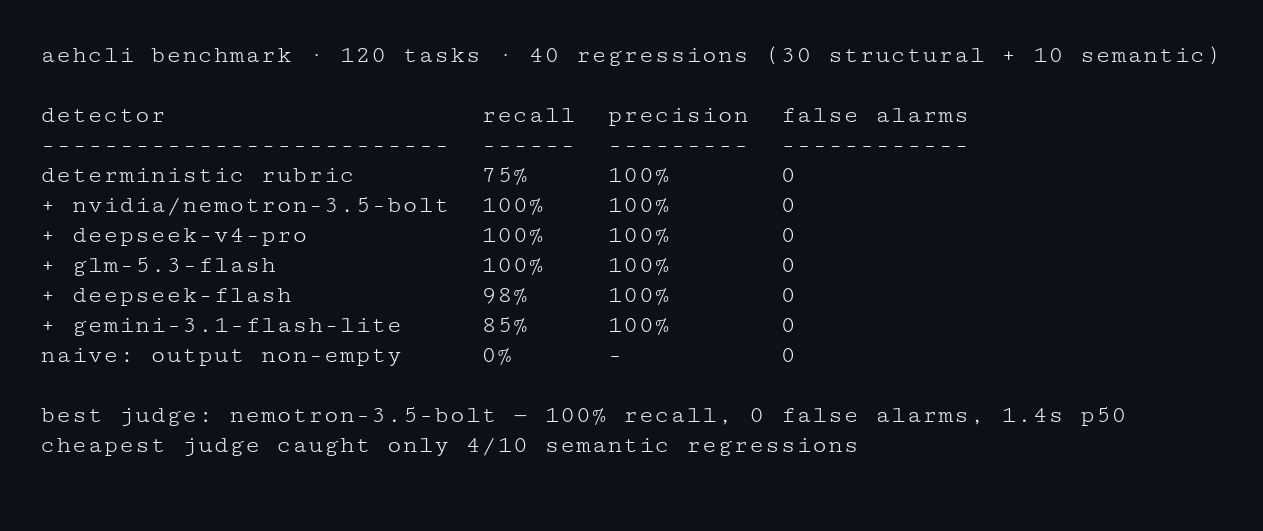
Four things stood out.
1. The smallest model won
nemotron-3.5-bolt-e4b is one of the smallest models in the set and it got
100% recall, 100% precision, zero false alarms, the lowest latency, and the
second-lowest token cost.
Judge quality is not about parameter count. It is about whether the model does what the prompt asks: read the rubric, check the output, return one number. A small model that follows instructions beats a large model that reasons its way into being charitable.
2. Zero false alarms everywhere
Not one model flagged a healthy run. The differences are entirely about how much of the semantic tail each one notices. That is a much better place to be than “everything is noisy” — it means the judge layer is safe to enable.
3. The cheapest judge was the worst judge
gemini-3.1-flash-lite used the fewest tokens and caught only 4 of 10
semantic regressions. A perfectly calibrated judge that never fires is worse than
no judge at all: it manufactures confidence. If you only look at cost per call,
you will pick exactly the wrong model.
4. Rate limits disqualify judges faster than accuracy does
Kimi’s quality was perfect on the subset. It is also unusable in CI: 3 RPM and 20 seconds per call. A judge that is right but cannot be called is a manual tool.
Judge selection is accuracy × reliability × cost. Optimizing only the first term is how you end up with a CI gate nobody trusts.
Bonus: does the host matter?
deepseek-flash is also served by NVIDIA NIM. Same nominal model, two hosts:
| host | recall | tokens | p50 | errors |
|---|---|---|---|---|
| DeepSeek direct | 98% | 87,273 | 1,560 ms | 0 |
| NVIDIA NIM | 100% | 51,265 | 6,278 ms | 8 |
Four times the latency, ~40% fewer tokens, same zero false alarms. This is not a clean isolation — the two endpoints expose different serving configurations — but it is enough to establish that “the same model name” does not mean “the same judge behaviour.” Benchmark the endpoint, not the model card.
What this means for your eval
- Split the work. Deterministic checks catch structural regressions for free and never false-alarm. Send only the cases that pass determinism to a judge. You get full recall at a fraction of the cost.
- Treat judge errors as errors.
score=0.0on an exception is a bug, not a verdict. - Give reasoning models a real token budget, and check
finish_reason. - Benchmark the endpoint, not the model. Hosting, rate limits and JSON-mode quirks all change the numbers.
- Pick a small, instruction-following model unless you have evidence that size buys you something on your dataset.
The harness
agent-eval-harness is a small, dependency-free Python package that ingests
OpenTelemetry GenAI or OpenInference traces, applies a rubric, optionally calls a
judge from a provider registry, and emits a JSON report you can diff in CI.
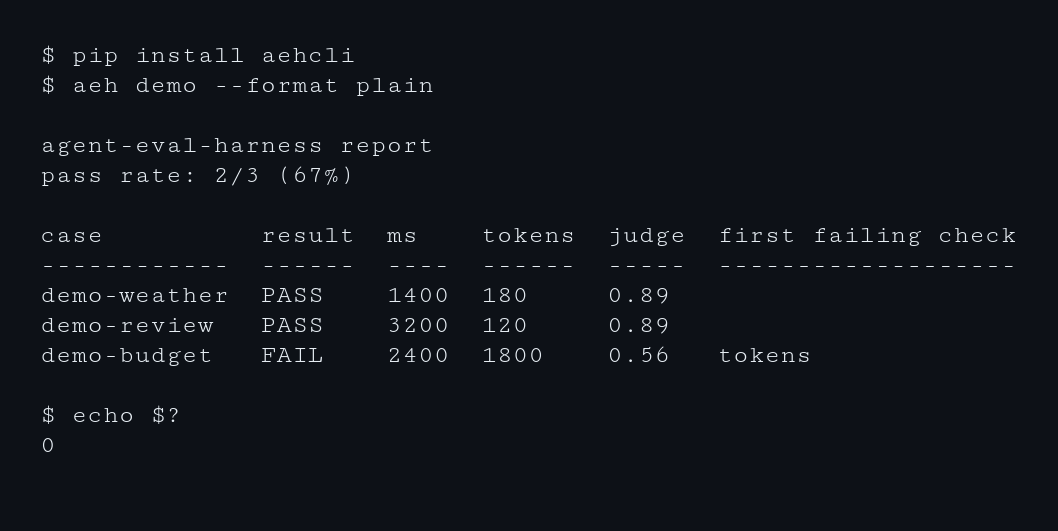
pip install aehcli
aeh demo        # built-in demo, no keys needed
aeh run --cases cases.jsonl --traces ./traces --judge-model nvidia/nemotron-3.5-bolt-e4b
aeh diff before.json after.json     # exits 1 on regression
Also available as npx aehcli, brew install laninenterline/tap/aehcli, and
docker run ghcr.io/laninenterline/agent-eval-harness:0.1.2.
- 29 unit tests
aeh judgeslists known providers- NVIDIA NeMo Agent Toolkit traces supported via the OpenInference normalization
layer (verified against
nvidia-nat1.9.0)
If you maintain an agent framework and want your traces supported, open an issue with a sample export — the adapter is ~50 lines.
The dataset is synthetic. The failure shapes mirror real model swaps, but the
numbers are not a claim about any specific model’s quality. Reproduce it with
python bench/generate_dataset.py && python bench/run_judge_compare.py.